
Mitigating Pica and Polydipsia Proactively: ‘Nee-Jerk’ vs. Needs-Led
Cite this article as: Batalla-Duran, L. (2026). Mitigating pica and polydipsia proactively: Nee‑Jerk’ vs. ‘Needs‑Led’. Ability Bridge SEND. https://www.abilitybridgesend.co.uk
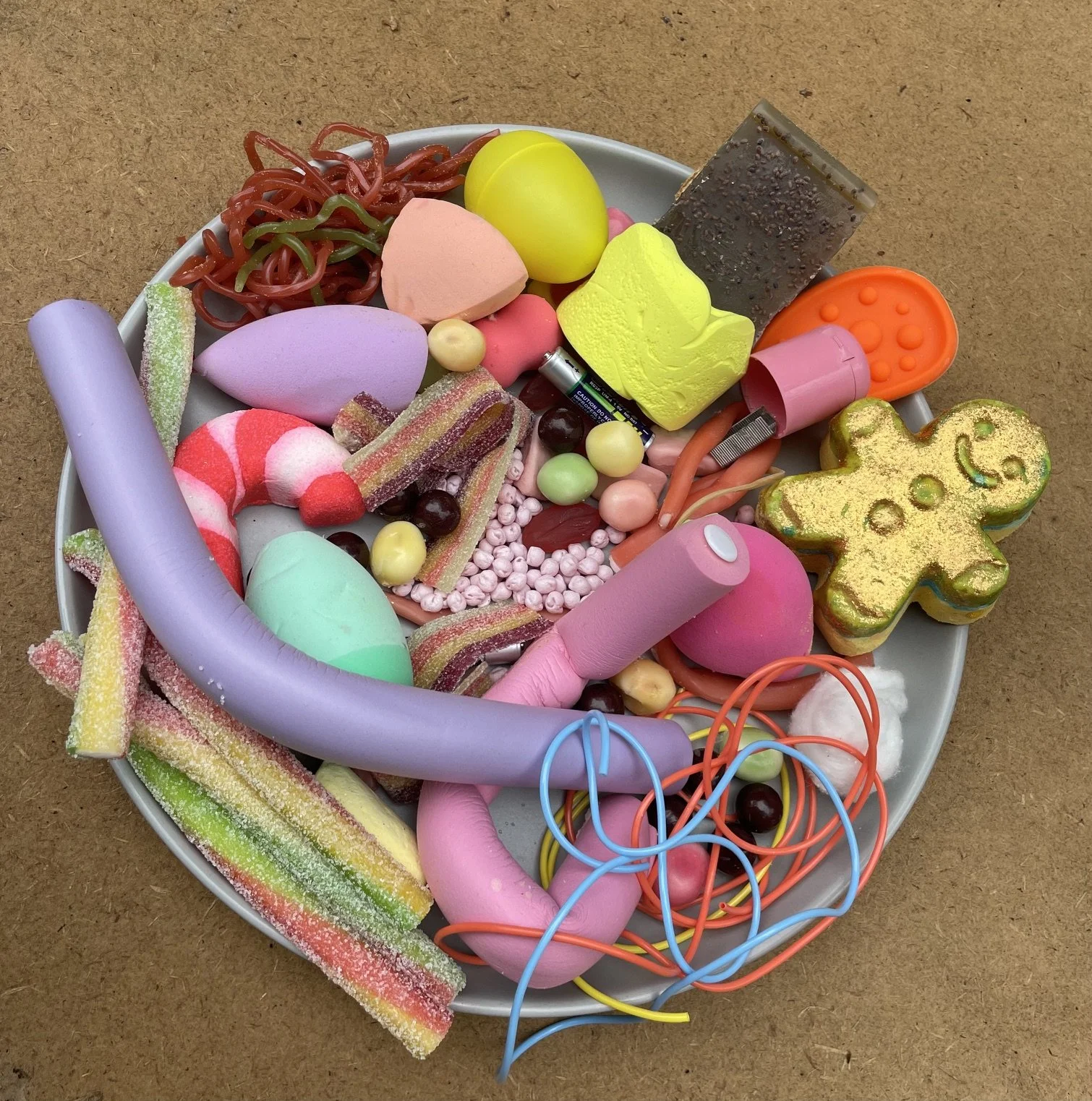
Examples of edible and non‑edible items - including types this pupil confused as edible, creating pica and polydipsia risk. Can you tell the difference.
Safeguarding and Knee‑Jerk Responses
Safeguarding incidents can trigger fast, emotionally charged (k)nee‑jerk responses; the ones that arise when individuals are met with something sudden, serious, and outside their control, a situation that’s all too common in school settings. Pica and polydipsia behaviours, particularly seemingly out‑of‑the‑blue first incidents and serious near‑misses, often result in such a response. By comparison, a needs‑led approach allows us to understand the underlying need and respond proactively in ways that reduce escalation, increase safety, and are sustainable long term, supporting everyone’s growth and well‑being.
Near‑Misses That Change Practice
The vast majority of my referrals come after a serious near‑miss, including a child ingesting a Christmas bauble, a six‑year‑old drinking a bottle of washing‑up liquid, a young person who required an object to be emergency surgically removed whilst choking on a plastic token, and one who had swallowed a toilet tab. My introduction to pica and polydipsia came through a similar serious near miss, just a month into moving from (a twenty‑two‑year career in) mainstream into special school.
A First Encounter With Pica
In 2018, a new colleague of mine came into my office, deeply distressed after receiving a seriously emotionally charged telling-off from a member of senior leadership. Whilst covering a class, a child has pulled a 15cm-long silicone toy out of her hand and ingested. Fortunately, the item went down the right way; no immediate danger. Unfortunately, we now had a child walking around with a sizeable silicone object somewhere in their intestinal tract and several deregulated adults.
When Adult Emotion Escalates a Situation
Mum’s understandable concern quickly snowballed into promises to contact the big ‘O’, inform the newspapers, and various other fearful things. Her emotions reflected what most of us parents feel in situations of pure fear, where we have no control over what happens next and are desperately trying to safeguard our child. This emotional state transitioned and magnified between parent, senior leader, and teacher. I felt for all three, for my colleague (a hardworking, diligent, and knowledgeable teacher and kind, sensitive human). Likewise, I felt for the senior leader, who (normally level‑headed and stoic, and one of the most incredible headteachers I have ever had the privilege of working under) was in fight‑or‑flight mode. Of course, it was a serious near‑miss for which she was ultimately accountable.
Supporting Regulation After the Near‑Miss
The immediate need was to calm the situation for everyone. The teacher was taken for a long walk and reassured that this was absolutely not her fault. Mum was called after, and three further calls were made over the Saturday and Sunday. Mum regulated quickly, expressed genuine thanks for the check-ins, and informed that A&E had advised seeing the GP if the item had not passed naturally within two days. Her daughter seemed fine in herself and her parental worry had massively subsided. The headteacher mouthed a slow exaggerated thank you to me at the calmer end of a meeting involving several senior leaders.
Searching for Answers
That weekend, research was done on pica. Next to nothing of value was found. The little information available appeared to simply state the problem with no mitigating suggestions, or only promoted a ‘remove all possible offending items from the environment’ response. More about pica, including the quintessential ‘why’, needed to be understood because, as Simon Sinek points out, it is the key to success.
The Unsustainable Blanket Ban Response
On the Monday after the incident, senior leadership were understandably anxious, and I found myself being taken from classroom to classroom as the suddenly appointed ‘pica lead’ to help inspect every item as an ‘expert’ on what was pica‑able and what was not. Unfortunately, the decided solution was an uncomfortable blanket ban on anything swallowable - including frequently used valuable maths resources, sound books because they contained button batteries (which are indeed one of the more common and serious pica‑able objects), and all marbles, which by default included a beloved marble run that was the only successful regulation tool for a nineteen‑year‑old with particularly challenging behaviour in another building several swipe‑only doors and over a hundred metres away.
This was difficult for staff, who were already in a heightened state due to the incident on the Friday afternoon, especially our literacy coordinator, who highlighted how valuable and frequently used these resources were for our pupils. It was a challenge for me; I had not long been at the school and was trying to speed up the process of creating a simple and practical solution, as it was immediately clear that a total ban was unsustainable, unworkable, and would impact pupils’ learning and staff wellbeing negatively. Removing the risk of pica and polydipsia simply by removing every potential item can be analogised with attempting to prevent Sleeping Beauty from pricking her finger by burning every spinning wheel in the kingdom.
Fairy‑Tale Wisdom
Fairy tales are stories historically used to pass wisdom through generations. Sleeping Beauty teaches many pearls; notwithstanding, being inclusive with fairy invites to Christenings is prudent. Contextually, it carries a salient moral that trying to prevent a behaviour simply by removing everything that might trigger or enable it is ultimately futile. The king had an understandable knee‑jerk reaction but fear prevents rational thinking. Burning every spinning wheel in the kingdom only dysregulated spinners due to the removal of their most needed tool; it didn’t successfully safeguard Sleeping Beauty. The spinning wheel wasn’t the risk; the behaviour was. It wasn’t the spinning wheel that needed eliminating; it was the behaviour.
Why Removal Alone is not the Complete Safeguarding Answer
Certainly, we can remove every symbolic spinning wheel we find, but sooner or later a young person will inevitably come across a non‑edible item that poses real safeguarding risk if ingested. This doesn’t mean we stop making environments safe; sensible clearance and protection through the immediate surroundings is basic safeguarding in every culture and environment in the world. It means we add a second, needs‑led prong that supports pupils to manage risk wherever they are. Relying only on removal is unworkable, unsustainable, and gradually makes a child’s world smaller and smaller, because we cannot completely control the immediate environment in school or at home; and once they are out in the community, we have extremely limited control at all. So the only option becomes to not let them outside in the community.
Fairy‑tale wisdom often shows how restricting access can intensify a quest: in The Little Mermaid, forbidding from going to the surface only strengthens her drive to reach it. Pandora’s Box shows the same pattern even more clearly; the prohibition itself created the overwhelming need to open it. The box was not the risk; the behaviour was. In the same way, removing every object does not remove the underlying need that drives pica or polydipsia. Indeed, research into pica and sensory‑seeking behaviours (Hagopian et al., 2011; Piazza et al., 1998; Kern et al., 2006; McAdam et al., 2004) shows the same pattern: removing items does not reduce the behaviour and can increase pica and polydipsia seeking when the underlying need remains unmet.
Developmental Stages and Safeguarding
Let’s look at the similar example of a typically developing baby who will start using their mouth to explore the world from about three months. This is not really too much of a safeguarding issue until they start crawling and being able to get their wee hands on to any and every object within their reach; the dangers are then stark: choking hazards, blockages, and poisonings from ingesting the wrong items. During this time, parents and carers automatically safeguard by ensuring a safer environment; securing cupboards and removing potentially dangerous objects in the accessible environment. However, they also put in a second essential safeguarding strategy; they meet need by providing large, safe alternative objects to mouth and opportunities to explore through hands and other senses. They will teach what is safe and what is not, they will distract and redirect their child, play with them, talk to them, occupy them in other ways… all under the safe umbrella of increased supervision. As developmental needs are met, the essential mouthing stage of learning is completed and they naturally move on to the next stage of development. With this, the need to remove every potentially dangerous item naturally reduces until it disappears entirely.
Second Pronged Safeguarding Strategy - Needs-Led Approach
The approach of removing risk objects during the oral‑developmental stage works successfully because a) it is sustainable for a short developmental period, and b) it is supported by a needs‑led approach. The needs‑led approach is arguably much more critical in supporting pica and polydipsia behaviours for several reasons, including the fact that we somehow manage to have ‘eyes in the back of our heads’ for the few months of the oral‑developmental stage, but this cannot be sustained for the possible years in which pica and polydipsia behaviours may occur. Older children are faster than toddlers, able to climb, often use chairs or inventive means to obtain out‑of‑reach items, have better dexterity, and cannot be popped into the safety of a cot for five minutes whilst you nip to the toilet.
Needs‑led support in pica and polydipsia involves the following stages:
Awareness of the existence of pica and polydipsia, and identifying individuals.
Understanding the unmet needs around pica and polydipsia.
Being able to identify what those needs are for each individual.
Meeting need through bespoke interventions.
What This Looks Like in Practice
In the case with the young lady in 2018, forming a collaborative relationship with Mum allowed us to unpick the behaviour and understand the unmet need being communicated. Mum had a light‑bulb moment during the weekend after the incident, when she found foam toy remains, make‑up sponges, and other items with bite‑sized chunks missing under her daughter’s bed and around the house.
Finding these pica‑ed items helped Mum recognise that the incident in school was an unforeseeable accident with no one at fault; in her words, “If my daughter can ingest that much foam under my very nose without me noticing, it’s no surprise that a teacher watching a whole class was helpless in stopping her ingesting the silicone worm.”
Through further discussion, we noticed that only items her daughter seemed interested in were coloured silicone and foam. Mum had a second light‑bulb moment. She realised that every Sunday she took her daughter to the market to buy giant lace sweets, which, even to a fairly trained eye, were not entirely dissimilar to the long purple silicone worm her daughter had ingested or the yellow and pink foam items. We hypothesised that the young lady was mistaking non-food items for sweets; the unmet need was being able to distinguish sweets from foam/silicone with possibly a sensory seeking need for the texture of these items.
Together we devised interventions to meet need across both school and home and implemented them.
The Bigger Safeguarding Picture
Ultimately, safeguarding pica and polydipsia cannot rely on environmental removal alone. Clearing immediate risks is necessary, but it is only ever one prong of a wider approach. When something frightening happens, adults can slip into knee‑jerk reactions (our own symbolic burning of spinning wheels). Fear without calm makes us act fast, but rarely wisely. It can leave staff, parents, and ourselves in a state of extremely poor well‑being. Well‑being is an often overlooked part of safeguarding, yet it is central to keeping our children, young adults, their parents and carers and ourselves safe.
Successful safeguarding comes when we pause, regulate ourselves, and think needs‑led rather than ‘(k)nee‑jerk’ led. It comes from identifying pica and polydipsia, understanding the underlying need(s), meeting it/them through bespoke intervention, and helping young people learn to navigate risk wherever they are. When we shift from reacting to incidents to meeting need, we move from fear to freedom; sustainable safeguarding for everyone.
If you’d find it helpful to explore the topic of pica and polydipsia further, I’ve created a needs‑led online course for schools. You can access it here:https://louise-s-site-a81e.thinkific.com/products/courses/pica-polydipsia-school-training
Hagopian, L. P., Rooker, G. W., & Rolider, N. U. (2011). Functional analysis of pica and the development of interventions. Journal of Applied Behavior Analysis, 44(2), 397–409.
Kern, L., Starosta, K., & Adelman, R. (2006). Restrictive interventions and their impact on problem behaviour. Journal of Positive Behavior Interventions, 8(4), 212–221.
McAdam, D. B., Sherman, J. A., Sheldon, J. B., & Napolitano, D. A. (2004). Behavioral interventions for pica in individuals with developmental disabilities. Behavior Modification, 28(1), 45–72.
Piazza, C. C., Hanley, G. P., & Fisher, W. W. (1998). Functional analysis and treatment of pica. Journal of Applied Behavior Analysis, 31(2), 165–189.
